
In September 2026, the Capgemini Research Institute found that only 28% of public sector organisations have successfully scaled their AI initiatives. For the rest, AI is still somewhere between a promising pilot and a service residents use every day.
Cities and islands are where AI has to work for real people every day. It is why Pleiades builds Urban Living Labs: places like Palaio Faliro and Chalki where startups test their technology with real data, alongside the operators and communities who will use it.
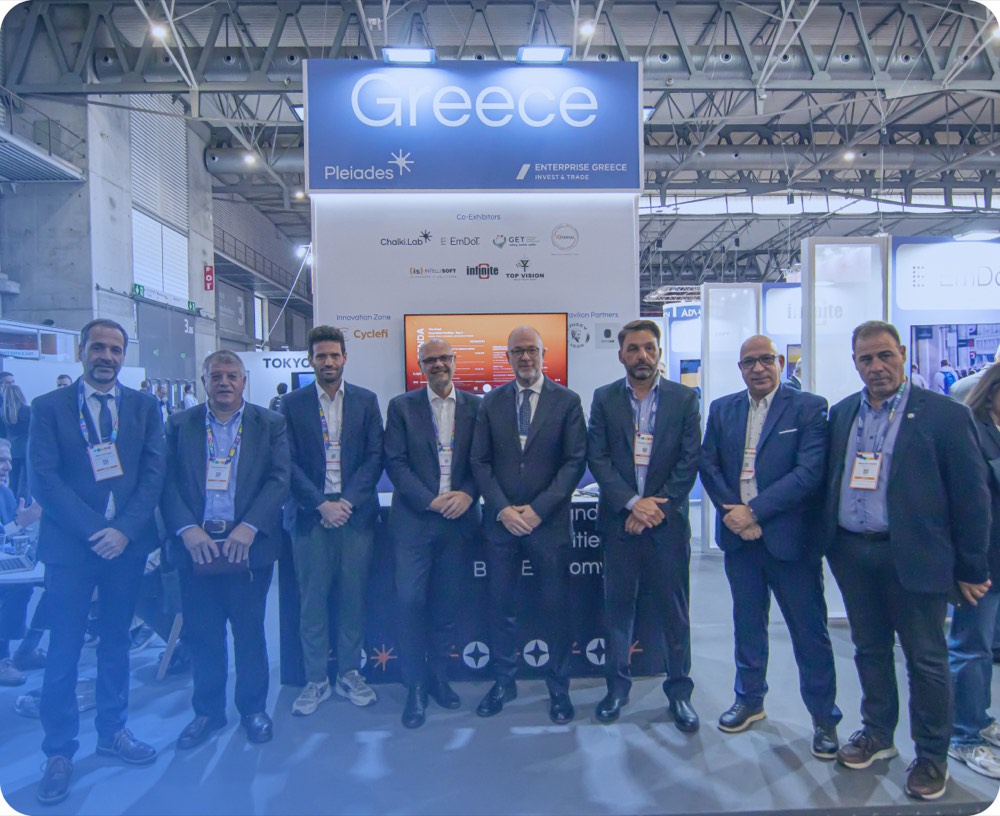
So when Pleiades co-organised the Greek National Pavilion at Web Summit Lisbon 2026 with Enterprise Greece, we set out to find Greek AI startups ready for those settings, and to give them a stage in Lisbon.
The brief: real challenges from our Labs
With every applicant, the Pleiades AI Open Challenge set out to discover whether AI is doing the actual work, and whether it would survive deployment in one of our Urban Living Labs.
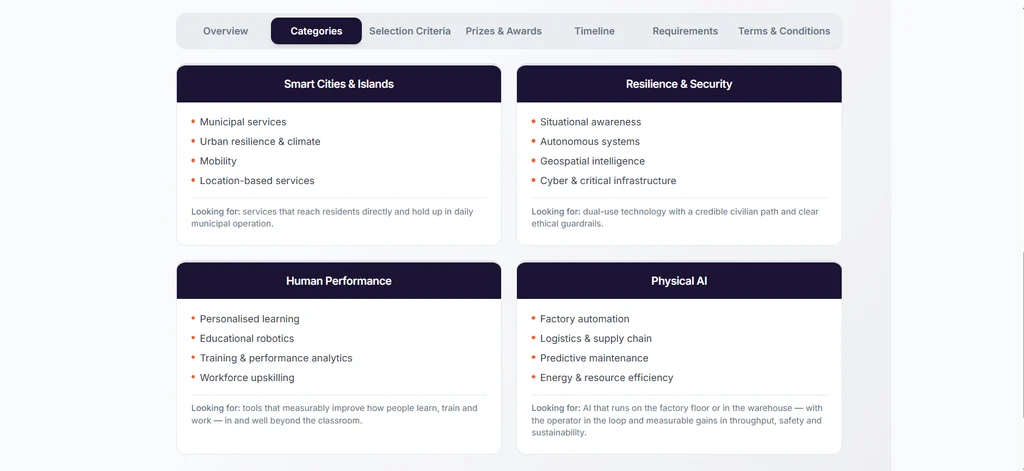
We framed the call around four tracks, each drawn from the challenges our Labs and members face today:
| Track | Where it lands | What we looked for |
|---|---|---|
| Smart Cities & Islands | Municipal services, urban resilience and climate, mobility, location-based services | Services that reach residents directly and hold up in daily municipal operation |
| Resilience & Security | Situational awareness, autonomous systems, geospatial intelligence, critical infrastructure | Dual-use technology with a credible civilian path and clear ethical guardrails |
| Human Performance | Personalised learning, educational robotics, training analytics, upskilling | Tools that measurably improve how people learn, train and work |
| Physical AI | Factory automation, logistics, predictive maintenance, energy efficiency | AI on the factory floor or in the warehouse, with the operator in the loop |
AI was a core requirement. Eligibility was deliberately practical: a working product at MVP stage or beyond, founded within the last six years, fewer than 150 employees, and incorporated in Greece or with a Greek co-founder.
The top three teams each won their way to Lisbon: first place its own startup booth in the Greek National Pavilion and flights, second place a Web Summit ticket and flights, and third place a Web Summit ticket. Every ticket includes access to the event platform for booking meetings with investors, corporates and founders.
The application window was short and fast, with a tight deadline to drive urgency: applications ran from 22 to 30 September 2026. To reach the right founders, we ran hyper-targeted campaigns on LinkedIn and Instagram and drew on our Enterprise Greece network.
The platform: one pipeline from call to result
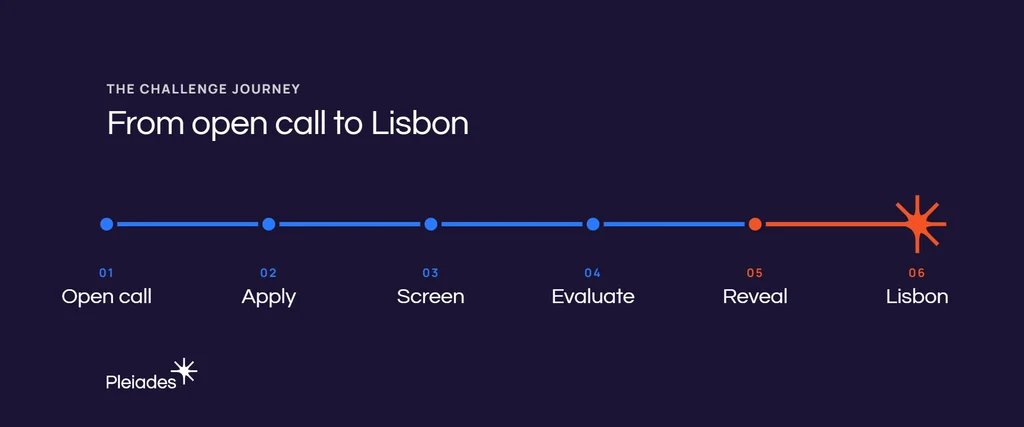
We ran the full challenge on InnoConnect, our internal innovation platform, which gave every applicant, evaluator and organiser one shared, transparent process:
- A public challenge page with the tracks, weighted criteria, eligibility, prizes and timeline, so founders knew how they would be judged before applying.
- Structured applications, putting every team’s problem, AI approach, traction and demo in the same format for fair comparison.
- A stage-based pipeline from submission through eligibility screening to scored evaluation.
- Built-in jury scoring, with evaluators scoring independently against the published criteria.
- A public results reveal, closing the loop for applicants and the wider ecosystem.
We’ve understood that founders invest their time where the rules are visible and the process has credibility, and that transparency attracts better applicants.
The evaluation: human judgement, with the Labs at the table
Every eligible application was assessed by an evaluation committee drawn from the pavilion’s co-organisers, with Enterprise Greece represented alongside Pleiades, and we gathered external feedback from reputable investor networks who back startups like these. Evaluators scored independently against the published criteria, and each score was weighted according to the evaluator’s impact on the ecosystem.
We also added a perspective few challenges include: an AI evaluator representing the Pleiades Urban Living Labs. Its role was to provide feedback and perspectives, asking where each technology could be deployed, who would own it, and what would measurably change for residents, visitors or businesses if it worked.
This gave the evaluation committee a clear view of the impact context. A strong maritime forecasting model reads differently once you ask what it means for an island port, a ferry schedule or a coastal municipality.
We relied on a human-in-the-loop model. AI played a significant role, giving every application the same impartial benchmark, but human evaluators were the final commenters and decision-makers, and all written feedback to non-selected teams came from their scores and comments. That reflects where good practice is heading under the EU AI Act: AI used transparently, with people accountable for the outcome.
The scoring: weighted towards what AI actually does
We weighted the criteria towards substance: Use of AI carried the most weight and maturity the least, so an early team with strong technology could still win.
| Criterion | Weight | The question we asked |
|---|---|---|
| Use of AI | 35% | Is AI doing the actual work, and is it done well? Models, data rights, quality, how errors are caught, and guardrails including the EU AI Act |
| Impact & path to adoption | 30% | What changes if this ships, and who pays for it? Measurable outcomes and a route to scale beyond one client or city |
| Problem fit | 20% | Is this a real problem in one of the four tracks, with an identified owner and evidence of need? |
| Maturity & demo | 15% | How far has it gone? Working prototypes, real data and live demos count for more than slides |
In the innovation process, two factors were central to the design of the brief. The first was the eligibility gate, applied before scoring, which screened out teams without a working product or with AI at the edge of their offer. The second was asking every team how they check that their AI’s output is accurate, and what happens when it gets something wrong. Teams already running in real operations answer this clearly, because they have had to solve it.
The results: 17 teams, three winners
In nine days, 17 Greek startups applied, bringing 45 founders and team members into the process. Thirteen passed eligibility and were fully scored, across education, legal tech, mobility, health, urban services, maritime and industrial AI, and the scores were close.
Three teams came out on top. Two of them work on the sea, which says something about where Greek AI has a natural edge.
1. AlongWave: trustworthy ocean data for shipping
Over 80% of world trade moves by sea, yet most of the ocean is barely measured. AlongWave builds AI that turns sparse, noisy ocean observations into reliable forecasts, delivered directly into the software shipping companies already use.
Why it won: AI is the core of the product. In the team’s own tests against real buoy data, its forecasts were more than 20% more accurate than leading global models, and it already has a commercial client and clear relevance for island ports and coastal operations. AlongWave wins its own startup booth in the Greek National Pavilion and flights to Lisbon.
2. Pharos Maritime: less time waiting at anchor
Ships spend 5–10% of their time waiting outside congested ports, at a cost of up to $34,000 a day. Pharos predicts congestion and tells operators when slowing down saves money and emissions.
Why it placed: strong problem fit and measurable impact. Replayed on 367 historical port calls at Richards Bay, its model cut average waiting time from 12.1 to 4.7 days. It runs on vessel tracking data alone, so ports benefit without any integration. Pharos wins a Web Summit ticket and flights to Lisbon.
3. Intelion: AI for pharma’s paperwork bottleneck
Before a pharmaceutical production line is approved, engineers review thousands of pages of certificates and test records by hand. Intelion’s AI reads, cross-checks and flags discrepancies, while engineers keep the final say.
Why it placed: a well-defined use of AI with a human firmly in the loop. On its benchmark, a review fell from around 14 hours to 20 minutes, and one real client project needed 91% fewer manual checks. The same engine travels to any regulated industry with heavy documentation. Intelion wins a Web Summit ticket.
What the three share is the thing we set out to find: AI doing real work, in a real operation, with results the teams can measure.
Next stop: Lisbon
From 9 to 12 November 2026, AlongWave, Pharos Maritime and Intelion join the Greek delegation at Web Summit Lisbon. The Greek National Pavilion is co-organised by Enterprise Greece, Pleiades, the Athens Chamber of Commerce & Industry and the Athens Startup Incubator.
The challenge was the first step. Large events reward preparation, so we are supporting the delegation with targeted meetings booked in advance and structured follow-up after Lisbon.
The longer goal is to bring these teams, and others like them, back home into our Urban Living Labs: a forecasting model proven at sea or a congestion model proven at port could just as well run in a Greek city or on a Greek island.
Find us in Lisbon. Visit the Greek National Pavilion at Pavilion 4, E422 to meet the teams and the Pleiades team.
Bring us a challenge. If you lead a municipality, an island community or an organisation with a problem AI could solve, our Urban Living Labs are where it gets tested.
Build with us. If you are a founder working on AI for cities, islands, resilience, people or industry, we want to hear from you before the next call opens.